


Overview:
This project is an advanced, multi-purpose computer vision system that combines state-of-the-art techniques for object detection, semantic segmentation, and human pose estimation. The system can identify and analyze a wide range of objects, human poses, and scenes in both static images and dynamic video content, including live camera feeds. It integrates powerful machine learning models and offers a highly configurable user interface to fine-tune performance for various use cases.
The system can detect different object categories, ranging from everyday items such as cars, bikes, and phones, to animals like dogs, cats, and elephants. It also provides semantic segmentation to precisely outline object boundaries and pose estimation for accurate human body joint detection. The flexibility of the system allows users to choose between detection, segmentation, and pose estimation, adjusting the settings to match their specific needs for confidence thresholds, frame intervals, and input sources.
Key Features:
- Comprehensive Object Detection:
- Object Categories: The system can detect a wide variety of objects, such as people, animals (e.g., cats, dogs, elephants), vehicles (e.g., cars, buses, airplanes), and even specific items like frisbees, food (e.g., pizza, sandwich), and household objects (e.g., chairs, bottles, laptops). This broad coverage makes it suitable for numerous applications.
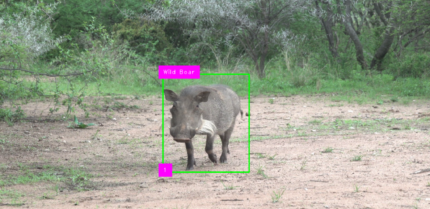
- Bounding Box and Confidence Scores: Detected objects are labeled with bounding boxes, and each object has a confidence score indicating the model’s certainty about the classification.
- Advanced Semantic Segmentation:
- Pixel-wise Object Identification: The system can provide detailed segmentation maps, where each pixel in the image or video is labeled with the corresponding object class (e.g., person, vehicle, background). This enables precise object boundary delineation for further analysis or processing.
- Accurate Object Contours: Segmentation outputs are ideal for use cases requiring high precision, such as medical imaging, robotics, and augmented reality.
- Human Pose Estimation:
- Keypoint Detection: The system can estimate human poses by detecting key body joints (e.g., elbows, knees, wrists, shoulders, etc.). This feature is especially valuable for applications in human-computer interaction, fitness tracking, and activity recognition.
- Real-time Pose Tracking: Human poses can be tracked across video or live camera feeds, allowing for dynamic interaction and analysis of human activities.
- Customizable Settings:
- Model Selection: Users can choose from multiple pre-trained models based on their specific needs (e.g., faster but less accurate models, or more accurate but slower models). The flexibility to choose the right model ensures that the system is adaptable to different performance and accuracy requirements.
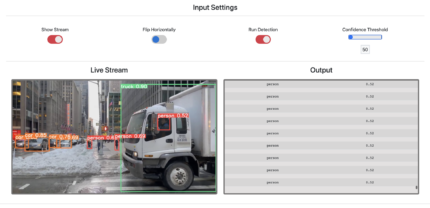
- Confidence Threshold Adjustment: Users can fine-tune the detection model’s confidence threshold to only show objects with a certain level of certainty. This is useful in scenarios where false positives are not acceptable, or where precision is critical.
- Frame Interval Control: Users can adjust the frame interval for video and live feed inputs, controlling how frequently the system processes frames. This can be used to optimize for performance or enhance real-time response times.
- Multiple Input Options:
- Static Images: The system supports processing single images for object detection, segmentation, and pose estimation, making it useful for applications like image-based search or inventory management.
- Video Processing: Video files can be uploaded for continuous detection and pose estimation, enabling applications in security, sports analysis, and more.
- Live Camera Feeds: The system can process live camera feed URLs, allowing real-time object detection and human pose tracking for use cases such as surveillance, smart home systems, and interactive installations.
- Real-time Performance:
- The system is optimized for real-time processing of both video and live feeds, ensuring minimal lag and quick updates. This is crucial for applications requiring immediate feedback, such as autonomous driving, real-time analytics, and security monitoring.
- User Interface:
- Intuitive Controls: The user interface allows users to easily configure model settings, select input types, and view results. It’s designed for ease of use with clear controls for choosing detection modes (e.g., object detection, segmentation, or pose estimation).
- Visual Feedback: Results such as object bounding boxes, segmentation masks, and pose keypoints are displayed on the interface, providing visual feedback that is intuitive and easy to interpret.
Technical Stack:
- Frameworks & Libraries: The system is built on top of popular computer vision and deep learning libraries, including TensorFlow, OpenCV, and PyTorch. These libraries enable fast and efficient implementation of complex models like YOLO (You Only Look Once), Mask R-CNN, and OpenPose.
- Pre-trained Models: The system integrates pre-trained models that can detect and segment a wide array of objects and estimate human poses. YOLO is used for real-time object detection, Mask R-CNN for segmentation, and OpenPose for human pose estimation.
- Languages: Python is used for backend development, with additional support for frameworks such as Flask or Tkinter for the user interface.
- Deployment: The application can be deployed on a local machine for personal use or on a server for scalability and accessibility. The system is designed to run on both CPU and GPU, allowing flexibility depending on available hardware.
Use Cases:
- Security & Surveillance:
- Detect and track individuals, vehicles, and other objects in surveillance video feeds. Pose estimation can also be used to identify suspicious movements or behaviors.
- Autonomous Vehicles:
- Identify and track surrounding vehicles, pedestrians, traffic signs, and obstacles in real-time. Pose estimation can help with analyzing human behavior on the road for safety.
- Retail & Inventory Management:
- Automatically detect and track products in retail environments, ensuring that shelves are stocked and items are properly identified.
- Sports Analysis:
- Analyze players’ movements and poses in sports videos to assess performance, track key actions, or provide feedback for training.
- Human-Computer Interaction:
- Use pose estimation for gesture-based control of interactive systems, VR/AR applications, and gaming, enabling more intuitive and immersive experiences.
- Healthcare:
- Analyze human poses for physical therapy or fitness applications. Semantic segmentation can be used to identify abnormalities in medical imaging.
Conclusion:
The Multi-functional Object Detection, Segmentation, and Pose Estimation System provides a versatile and robust solution for a wide range of computer vision tasks. Its powerful object detection, semantic segmentation, and pose estimation capabilities, coupled with customizable settings, make it suitable for both research and practical applications in areas such as security, sports, retail, healthcare, and autonomous vehicles. By offering real-time performance and multiple input types, this system provides users with a flexible, efficient tool for analyzing visual data in numerous domains.









Reviews
There are no reviews yet.