

Project Overview
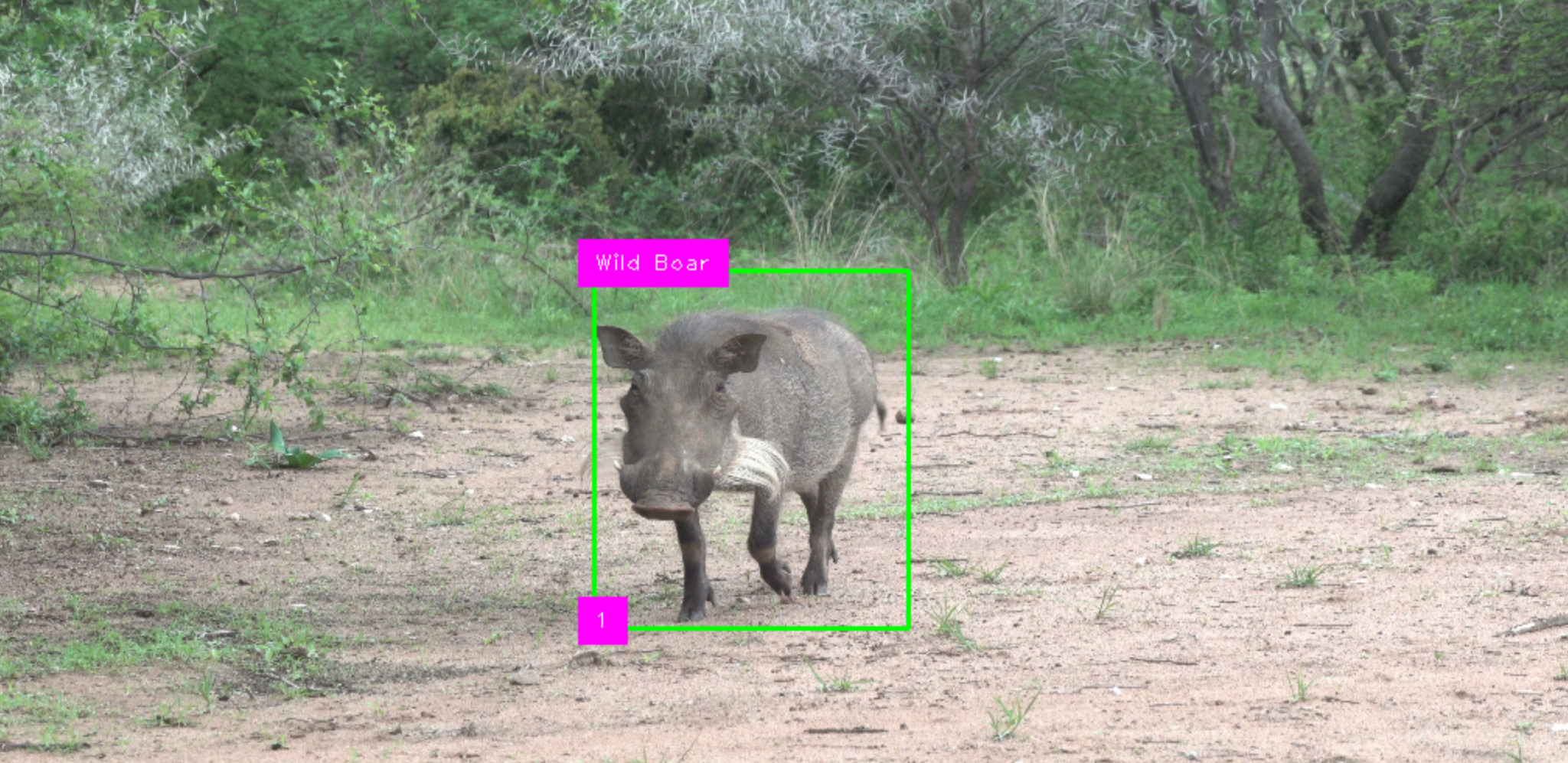
The Wild Boar Detection project aims to develop an intelligent and efficient system capable of detecting wild boars in real-time through visual surveillance. By leveraging a deep learning-based object detection model, specifically the YOLO11(You Only Look Once), the project seeks to automate the identification of wild boars from images or video streams in natural environments. This system can play a crucial role in wildlife management, agriculture, and ecosystem preservation by providing timely detection of wild boars in sensitive areas.
Project Objectives
- Accurate Wild Boar Detection: Create a robust system capable of detecting wild boars in various environmental conditions, including forests, agricultural lands, and near urban areas.
- Real-Time Performance: Develop a solution that works in real-time, enabling immediate response to sightings of wild boars.
- Automated System: Build an automated detection pipeline that reduces human involvement and enhances efficiency.
- Scalability: Enable the model to scale from individual cameras to large networks of surveillance systems.
Technology Stack
- Model: The project utilizes the YOLO11 (You Only Look Once, version 5) object detection model, known for its high performance, efficiency, and ability to detect multiple objects in real-time with minimal computational overhead.
- Dataset: A custom dataset consisting of images and videos of wild boars taken in natural environments, labeled with bounding boxes around the boars.
- Programming Languages: Python, with popular libraries like PyTorch for training the YOLO11 model, OpenCV for video/image processing, and Matplotlib/Seaborn for result visualization.
- Environment: Google Colab or local machine with GPU support for model training; cloud services like AWS or Azure can be used for deployment.
Methodology
- Data Collection and Preprocessing:
- A dataset of images containing wild boars in different natural settings is gathered. The images are annotated with bounding boxes around each wild boar for training the object detection model.
- Data augmentation techniques such as scaling, flipping, and color adjustment are applied to diversify the dataset and increase robustness.
- Model Selection and Training:
- The YOLO11 model is selected due to its state-of-the-art performance in object detection tasks, particularly its speed and accuracy.
- The YOLO11 model is fine-tuned using the custom dataset of wild boars to improve its accuracy in detecting this specific class of animals. The model is trained for several epochs until convergence, with the best weights saved in a
.ptfile.
- Model Evaluation:
- The trained model’s performance is evaluated on a separate validation dataset.
- Performance is also evaluated for real-time inference to ensure the model can operate with minimal latency in field conditions.
- Deployment:
- After training, the model is integrated into a real-time detection pipeline that processes incoming video feeds or images from surveillance cameras.
- The system outputs bounding boxes around detected wild boars, providing alerts or logging sightings for further action.
Results and Impact
- Detection Accuracy: The YOLO11 model provides highly accurate wild boar detection, even under varying light conditions and environmental settings.
- Real-Time Detection: The system demonstrates the ability to process video feeds in real-time, making it suitable for live surveillance applications.
- Scalable System: The project can be extended to handle multiple camera inputs, creating a scalable surveillance system for monitoring large areas.
Conclusion
This project demonstrates the effectiveness of YOLO11 for real-time detection of wild boars, offering significant improvements in monitoring wildlife and managing invasive species. By automating the detection process, the system provides a reliable, cost-effective solution for wildlife conservationists, farmers, and authorities dealing with wild boar populations.







Reviews
There are no reviews yet.